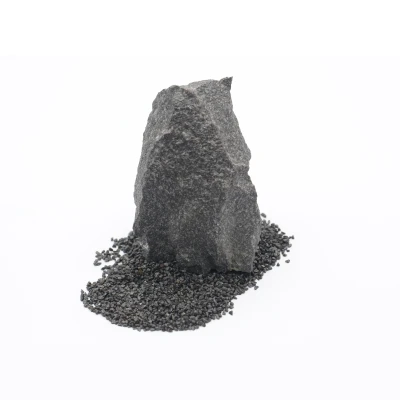
Refractory raw materials are usually divided into aluminum-silicon refractory raw materials (siliceous, clay, high aluminum, etc.), alkaline refractory raw materials, thermal insulation refractory raw materials and other refractory raw materials.
Due to the volume effect of quartz variants, silica bricks are also made directly from silica, which is a general term for gangue quartz, quartzite, flint and sandstone. The main component of silica is SiO2, and the others are impurities. The siliceous raw materials used in refractories are crystalline rubble and cemented silica.
Fireclay is the main raw material for the production of aluminum silicate refractories, and its refractoriness requirements are higher than 1580 degree C of all kinds of hard clay, soft (semi-soft) clay and clay shale, which are collectively referred to as fireclay.
Natural fireclay is usually a clay ore mainly kaolinite (Al2O3 2SiO2 2H2O) as its main component, that is, water-containing silicate as the main body, and mixed with free quartz, pyrite, rutile and organic compounds composed of a mixture. Most of these non-homogeneous minerals are dispersions composed of particles less than 1.2μm in diameter.
① Hard clay is characterized by dense tissue, large hardness, extremely fine particles, water is not easy to disperse, and plasticity is very low. Such clays are usually light grey, off-white or grey in appearance. Shell-like fracture, some surface has a sense of smoothness, easy to break into pieces.
② Soft (semi-soft) clay is often blocky, soft tissue and good plasticity. The color of this clay varies greatly due to the different types and contents of impurities. From gray to dark gray to black; Some are purple, pale red or white.
(1) Bauxite
Bauxite is the main raw material for the production of brown corundum, and high aluminum clinker with Al2O3 content of 88%90% is the main raw material of subwhite corundum. Production of white corundum, dense corundum and other alumina as raw materials. Bauxite is also known as high bauxite or bauxite, the main minerals are diaspore (Al2O3 H2O) and trihydrate (Al2O33H2O).
China has vast reserves of bauxite: it is produced from Shanxi, Hebei and Shandong north of the Yellow River, through Henan and Guangxi in central China, to Guizhou and Yunnan in the southwest. At present, the main producing areas of high bauxite clinker are Shanxi, Henan and Guizhou. There are also some smaller mines under development in Hunan. The main minerals of bauxite in China are hydrobauxite, boehmite, kaolinite and pyrophyllite, which can be divided into three types according to its mineral composition: hydrobauxite-kaolinite type (DK); Boehmstone-kaolinite type (BK); Hydrobauxite-pyrophyllite type (DP). At present, DK type bauxite is the most widely used, DK type bauxite clinker is divided into S, Ⅰ, ⅡA, ⅡB, Ⅲ and so on according to its Al2O3 content.
(2) sintered corundum and fused corundum
Artificial production of corundum is the use of industrial alumina or high bauxite as the main raw material, melting in the arc furnace to produce. In addition, corundum plate alumina can be obtained by sintering method. This method is still based on industrial aluminum oxide powder as the main raw material, through calcination, fine grinding, ball formation and firing. This method is difficult to produce technology, but the product has high strength, strong corrosion resistance and good thermal shock stability. The so-called "sub-white corundum" is actually a dense electric fused corundum based on high bauxite, the Al2O3 content is greater than 98%, the apparent porosity is less than 4%; It is made of high bauxite by electromelting under reducing atmosphere and controlled conditions. Corundum crystal is granular, generally 115mm; The main impurities are rutile, aluminum titanate and its solid solution.
(3) Mullite
Mullite is a refractory material with 3Al2O32SiO2 crystalline phase as its main component. Mullite is divided into natural mullite and synthetic mullite. Natural mullite is rare and is generally synthetic. Mullite is chemically stable and insoluble in hydrofluoric acid. It has good high temperature mechanical and high temperature thermal properties, so the synthetic mullite and its products have the advantages of high density and purity, high temperature structural strength, low high temperature creep rate, low thermal expansion rate, strong chemical erosion resistance, thermal shock resistance and so on.
(4) sillimanite group minerals
Sillimanite group minerals include cyanite, andalusite, sillimanite, commonly known as "three stones". The chemical composition of the three stones is the same, but the crystal structure is different, and it is a homogeneous crystal. Heated to high temperature, are converted into mullite, generating a small amount of molten SiO2, while accompanied by volume expansion.
4.1 Magnesium raw material
(1) magnesite
(2) Other minerals containing magnesium
The main mineral composition of magnesium olivine products in magnesium refractory materials is magnesium olivine (2MgO·SiO2) and cubic magnesite (MgO). This product is characterized by strong resistance to molten iron oxide and better thermal shock stability than ordinary magnesia brick. The main raw materials for the production of this product are peridotite and serpentine.
4.2 Dolomitic raw materials
Dolomite is a refractory raw material mainly composed of double salts of magnesium carbonate (MgCO3) and calcium carbonate (CaCO3). Its chemical formula is CaMg(CO3)2 or MgCO3 CaCO3, and its theoretical composition is CaO3 0.41%, MgO2 1.87% and CO2 47.72%. CaO/MgO=1.39, hardness is 3.54.
5. Raw materials for zirconium products
(1) Zircon stone
Zircon (ZrO2·SiO2 or ZrSiO4) is the main raw material for the production of zircon products and zircon products, and the origin of Zircon in China is Hainan Province. It is found in Guangdong Province, Guangxi Zhuang Autonomous Region, Shandong Province, Fujian Province and Taiwan Province.
The theoretical composition of zircon is ZrO2 67.01% and SiO2 32.99%. It often contains TiCfe and other trace rare earth oxides, which, due to the presence of these elements, make it radioactive to varying degrees. Therefore, when using this raw material to produce products, there should be necessary protective measures.
Zircon has a low thermal conductivity of 3.72W/(m.K) at 201000 degree . The expansion coefficient of zircon is also low compared with other crystals, 4.6X10⁻⁶ degree at 1000 degree , and the expansion coefficient of its single crystal in the two directions of the vertical and parallel main axis (C-axis) has a large difference. Zircon has high chemical inertness and is difficult to react with acid. Reacts with glass melt to a lesser extent, it is often used in metallurgy and glass industry refractories.
(2) plagiozircon
Natural zircon (ZrO2) is often irregularly lumped, black, brown, yellow, or colorless. There are few natural inclined zircon ore bodies in China. ZrO2 used in industry is a chemical raw material, which is a white or yellowish powder obtained by chemical method from zircon (ZrO2·SiO2).
Pure ZrO2 has three crystal forms at atmospheric pressure: monoclinic, tetragonal and cubic phases from low to high temperature.
Stable ZrO2, according to its degree of stability, there are partially stable ZrO2 and fully stable ZrO2 points, because the fully stable ZrO2 thermal expansion coefficient is larger, its thermal shock stability is not as good as the partially stable, so the latter is commonly used to make ceramics and refractory toughening materials.
(3) desiliconized zirconium
(4) zirconium corundum mullite
The original raw materials are industrial alumina, kaolin and zirconite, which are finely ground and mixed evenly, semi-dry pressure ball and calcined at 3001700 degree to produce this material. The results show that increasing zircon content leads to increasing sintering temperature, decreasing total shrinkage and increasing closed porosity. These reactions make sintered zircon corundum mullite have higher density and strength and better thermal shock resistance stability.
6. Raw materials for chromium products
One of the main raw materials for the production of chrome (chrome brick, chrome magnesia brick, magnesia chrome brick) refractories is chromium ore or chromite. Chromite is a mixture of a variety of minerals, because its mineral composition fluctuates greatly, in terms of chemical composition and physical properties change is also large. It is usually composed of gangue minerals with chromic grains. These gangue minerals are usually magnesium silicates, such as serpentine, magnesium olivine and olivine. In addition to Cr2O3 in chromite, there are also Al2O3, Fe2O3 and MgO, general chromite, due to the presence of magnesium and iron, often expressed as (Mg, Fe) Cr2O3.